Posts

A New Kiln Build

In rural part New Hampshire, a wood fired kiln is being built by the New Hampshire Potters Guild.  This kiln will replace a 30-year old, tired, kiln.  I'm creating a short film to document the event.   The short (30 seconds) video provides a glimpse of the beginning of the process.  Watch for more.

Porcelain in Name Only

Image
Notwithstanding Indigenous peoples of the Americas, during the early years of the last century American individuals using their hands to form clay into pottery were referred to as vessel makers.  Ceramic vessel making was practiced as either vocational education (to provide skilled labor to industry), therapeutic activity for people with nervous disorders or as a hobby. Serious hobbyist frequently dug their own clay from local deposits, built their own wood fired kilns and wheels and mixed their own glazes.  It was a process of trial and error to teach yourself to be a potter before 1950. By the time I was introduced to clay in the late 1960's and taking my first baby steps as a ceramic artist, formal training existed. Suppliers mined raw material and sold clay and raw materials to schools and hobbyists. Clay was mined or manufactured as low-fire (earthenware), high-fire (stoneware) and porcelain.   Low-fired earthenware cannot be made vitreous and historically has...

Endless Variations of Shino

Image
Cleaning up and purging in preparation for 2024, I found this small cup that I had thrown more than a decade ago.  It was fired in my gas kiln using Malcom Davis' Carbontrap Shino glaze recipe.   It is only about 3 inches in diameter and less than 2" high.  I'm sharing this because the Shino glaze gave me the orange peel look that I was hoping to achieve and is prized by some fans of Shino glazes.   For you that are new to Shino glazes this example of only one type of Shino glazes.  In 2005, I traveled to the annual NCECA conference being held in Baltimore, MD.  As part of the conference,  Baltimore Clayworks was exhibiting  Shino Review 2005.   The exhibit was curated by Malcom Davis. In his curator's statement Mr. Davis explained that "Shino is not so much a particular formula as it is an appearance, offering a deep, warm, friendly and non pretentious appeals to our tactile and visual senses and visual senses.  What we s...

My Affinity for Shino Glaze

Image
After moving to New Hampshire in 2000, I took a ceramic course at the New Hampshire Art Institute (now part of the College of New Hampshire).   There I found a group of potters who introduced me to Shino glaze. Shino glazes were used by Japan potters during the 16th century.   They were known for their characteristic warm white finish, earthy tones, speckled surfaces, and subtle crawling effects. Unfortunately, the recipe for the glazes faded away around the late 17th century and became lost. Through extensive analysis of surviving Shino pottery scholars attempted to piece together the lost recipe. In the 1930s and 1940s, two Japanese potters, Toyozo Arakawa and Hajime Katō, developed the first modern Shino glaze by studying Momoyama Shino pots. Working independently in 1974, Virginia Wirt, a student of Warren MacKenzie at the University of Minnesota, developed a glaze formula that emulated the characteristics of the Japanese Shino glaze.  ...

It's been a bit...

 I forgot this blog existed, but rediscovered it today as I was trying to navigate around a new hosting plaform for RockPondPottery.com.  SquareUp changed their subscription model last month.  To continue with a custom domain name, the annual cost nearly tripled.  They are still hosting my site under a no cost subscription, but the url has changed.  One now only can find my website using a sub-domain.  Translation, the website is now www.rockpondpottery.square.site I know.  Just doesn't give the audience the same feel.  But for now that is what I have.  Untill I find a new hosting partner.

17May2015 Flying Back to USA

Image
In Paris, upgraded to the upper deck to get us out of those God awful emergency row seats down below.  Very comfortable.  Ahhhhhhhh. Touchdown at 6:15p pm...Boston...7.5 hour flight.

16May2015 - Talk about Fresh!

Image
This is a picture from the center of Devil's Bridge looking at a restaurant in the upper right...you can see the patio chairs. The garden below the restaurant is where the chef grows what he serves. Unfortuately for us, it was just after the mid day serving was closed until 5.

16May2015 - Olargues

Image
The travel books say the Olargue (o LAR gah) is one of France's most picturesque towns.  This stone town built by the Romans certainly has the most cats.  Plus, going from the town hall to the inner parts of the town makes one feel like a mountain goat. May must not be season yet as the town was completely void of people.  It was the 2 hour lunch time, but we met only one shop owner in a one hour exploration of the town. The second picture was a sample of a Rue in the town...that wasn't going up or down. The third picture is from one of the cliffs above the town...looking down at Devil's Bridge...a structure built by the town inhabinants in the 13th century.

Happy Hour in Olargues

Image

15May2015-Dinner on the Mediterranean

Image
....and desert....for 60 Euros!

The Cathers

Image
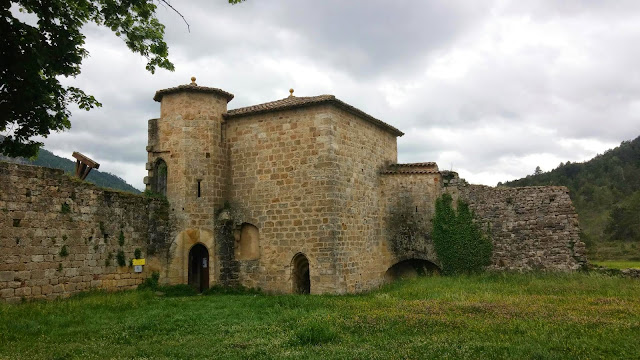
People who followed a religious practice which the Roman Catholic church believed to be heretical are referred to as Cathers (CAT-tars).  I think they must have been medieval hippies.  They didn't like the feudal system or the role the Church had in society.  Of course the church couldn't take this sitting down. During the Inquisition, the Cathers we're persecuted. There is a trail that follows the Aude river that is associated with the Cathers. Along this route are castles from the 12th century that is connected to this religious group. Best I can tell, some of the Fathers were Lord's who owned these castles and during the Inquisition, they were attacked and the Lord's list their holdings. This castle is in Argues just west of Couiza. The spiral stone stairs between the four floors in the tower are original...The iron railing was added when it was restored. Amazing these stairs are cut by hand and set stop one another...and they still function....who needs engine...

14May2015-City of Nimes - Arena

Image
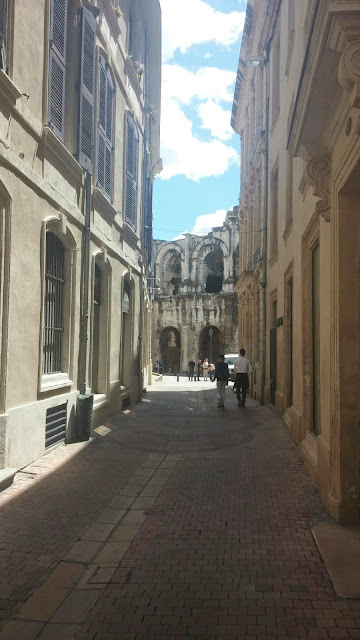
I'm the heart of the city...what was the Roman city...stands the Colosseum...or Arena, as referred to today.  Built by the Romans in the 1st or 2nd century AD, the arena still is used commercially for concerts and bull fights. What do cool. You walk down these narrow streets full of contemporary shops and as you turn the corner, there stands a nearly 2000 year old structure. (First Picture)

14May2015 - a ton of speculation(Pics)

Image

14May2015 - A ton of Speculation

(Blogger lost the post associated with the pictures...so again) South of the city of Carcassonne is the small town of Couiza. Just south of Couiza is the Rennes-le-Chateau built on top of a hill. It is associated with the Dan Brown book about alledged, secret Roman Catholic events. The church is a bit strange with the devil holding the baptisamal fountain.  Over the door reads..."Terrible Ici"...(picture in previous post) I'm 1909 a priest came to the small church and without any visible means he purchased land adjacent to the church and began to build the chateau. When he was defrocked...no big deal, he just went next door to his chateau. The myth is that this priest found evidence of Jesus traveling to France and having a family with Magdeline.  Using this info, he blackmailed the church.

13May2015 - Carcassonnne

Image
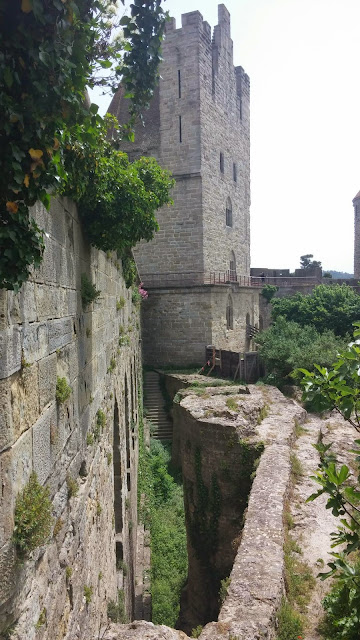
Damn Mobile Blogger...it keeps losing my posts....tomorrow! OK...next morning...Let's try this again. Carcassonne is a city the lies between Touloues and where we are staying. Just outside the city is the medieval ruins of Carcassonnne that date back to the Romans. If you google Carcassonne you will get better info than I can provide. In the 12th century it was further fortified with a second wall. In the last of the pictures below you see the higher medieval wall on the right, and a smaller wall on the left with a gravel area between.  The wall on the left is the newer wall...the rampart. Since it is built on a hill, the picture is deceiving. The rampart is probably 30 to 4o feet high...and then the medieval fortress stands behind that...so the gravel walking area is 40 feet above the city below. I'm the early 20th century, a forward thinking gentleman began to restore the medieval fortress and inner city. There are a few private residence, but it mostly it consists of res...

Oh, I like driving in southern France

Our female, British accented, GPS took us to Carcossonne using local roads and not the A61 motorway.  What a treat. Two lane roads that pass many vinyards and beautiful wineries...tree lined sections of road where the branches form a canopy over the roadway...quaint small villages.  One had to share the road with bicycle tourista and farm implements....and if you didn't stay the speed limit of 90 km/hour...you would be passed by all manner of vehicles.  Out little VW Gulf passed with the best of them!!!!  Fun.

My Next Fixer-upper

Image
On the way into Carcassonne, I found this cute little fixer-upper.  Perhaps our next homestead?

Logistical Note

The home we are staying at in Autignac has no Wi-Fi or cell service.  I will be writing a number of post and during the day, when I can find either service, I will upload the most. Merci Beaucoup

Toulouse to Autignac

Ah yes, driving in France.  We rented a VW gulf with a TomTom GPS.  We had a problem with the GPS and my Google Maps fighting one another getting out of Toulouse, but eventually we made it to the motorway. 2.5 hours later, going 130 km/h we arrived at the house. Very nice 3 bedroom, typical old French home in the center of the city. The roads are no wider than a driveway in the states... small cars, you have to love em.  We were exhausted from traveling, but we did find the market on the way in.  Wine, cheese and bread for dinner.  We had our full of that day...off to bed.

Escape from Paris - Part II

Image
From Giverny we traveled to Versailles, the site of Louis XIV palace and gardens. My impression: Lou was a small minded man who thought if he built grand surroundings, he himself would be grand. He'll, he even called himself the Sun King...as if he would bring light and enlightenment into the world. In 1661 he took 1000 acres in Versailles that his father and court liked to hunt, and converted the site of a hunting lodge into a grand Palace.  He hired architects, painters, sculptors and other artisans to great a new capitol if France. All of for show (IMO).  He may have thought it splendid, but it reminded me of a 21st century nuevo rich person that instead of building a home with originality and design principles he/she has acquired through the years, copies what he/she has seen elsewhere. Example...there is a statue of Lou that has him dressed as a Roman soldier...as if this were a part of his past.  What at farce...and I'm sure the good people of France new it as a fa...